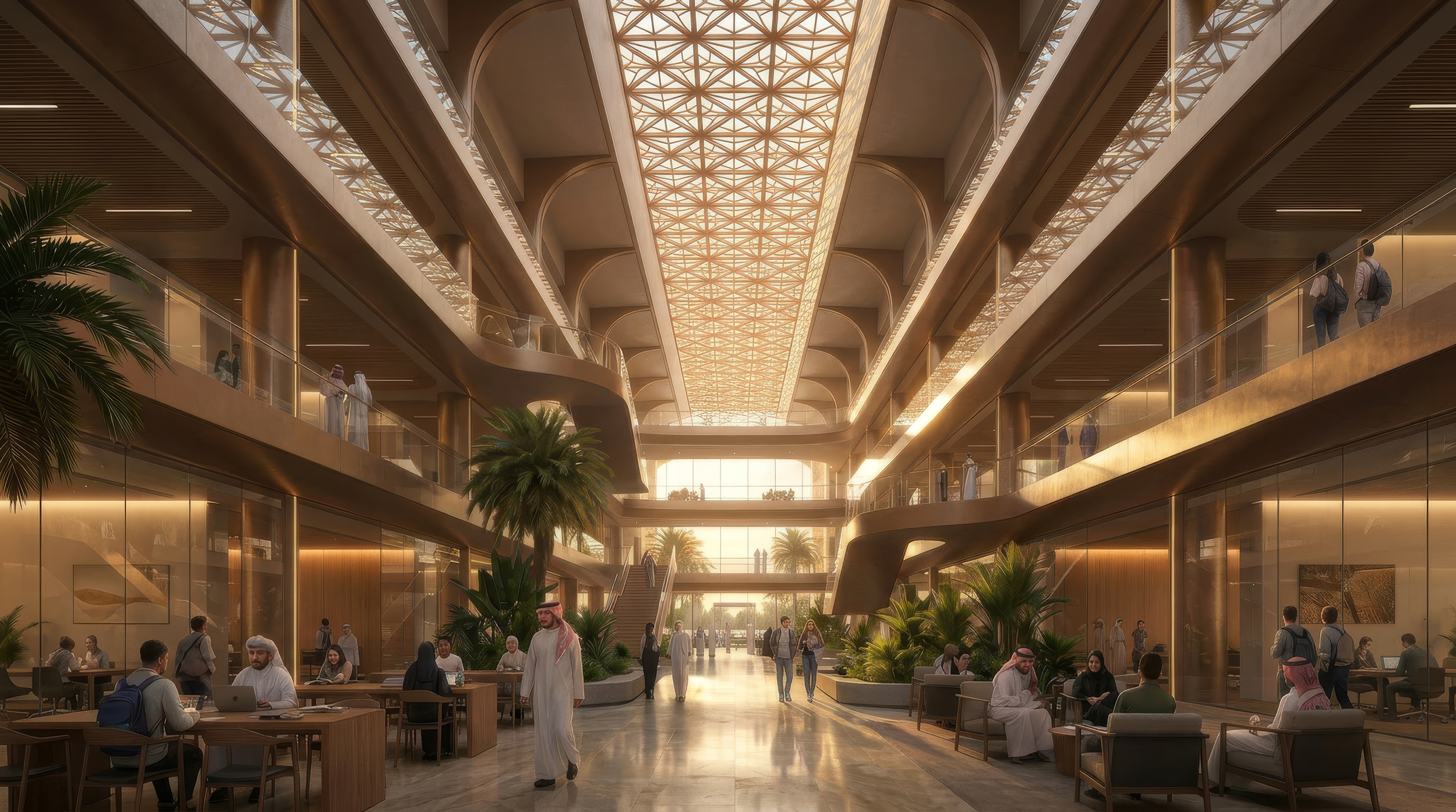
The Vision.
Our vision is to establish a state-of-the-art university in the vibrant and rapidly developing north of Jeddah, Saudi Arabia — a hub where tradition meets innovation. This institution will redefine higher education in the region by offering forward-looking curricula shaped by emerging global trends and powered by artificial intelligence. Each program will be designed to provide students with not only foundational academic knowledge, but also the digital fluency, critical thinking, and adaptive skills needed to thrive in tomorrow’s economy.

Aligned with Saudi Vision 2030, this university will serve as a cornerstone for building a knowledge-based economy, fostering innovation, and empowering youth to compete on a global scale. Its AI-driven curriculum will transform the way knowledge is delivered and applied, giving graduates a distinct advantage in an increasingly competitive world. By integrating advanced technologies into learning, the institution will position itself as a leader in educational innovation across the Arab world and beyond.
Vision 2030
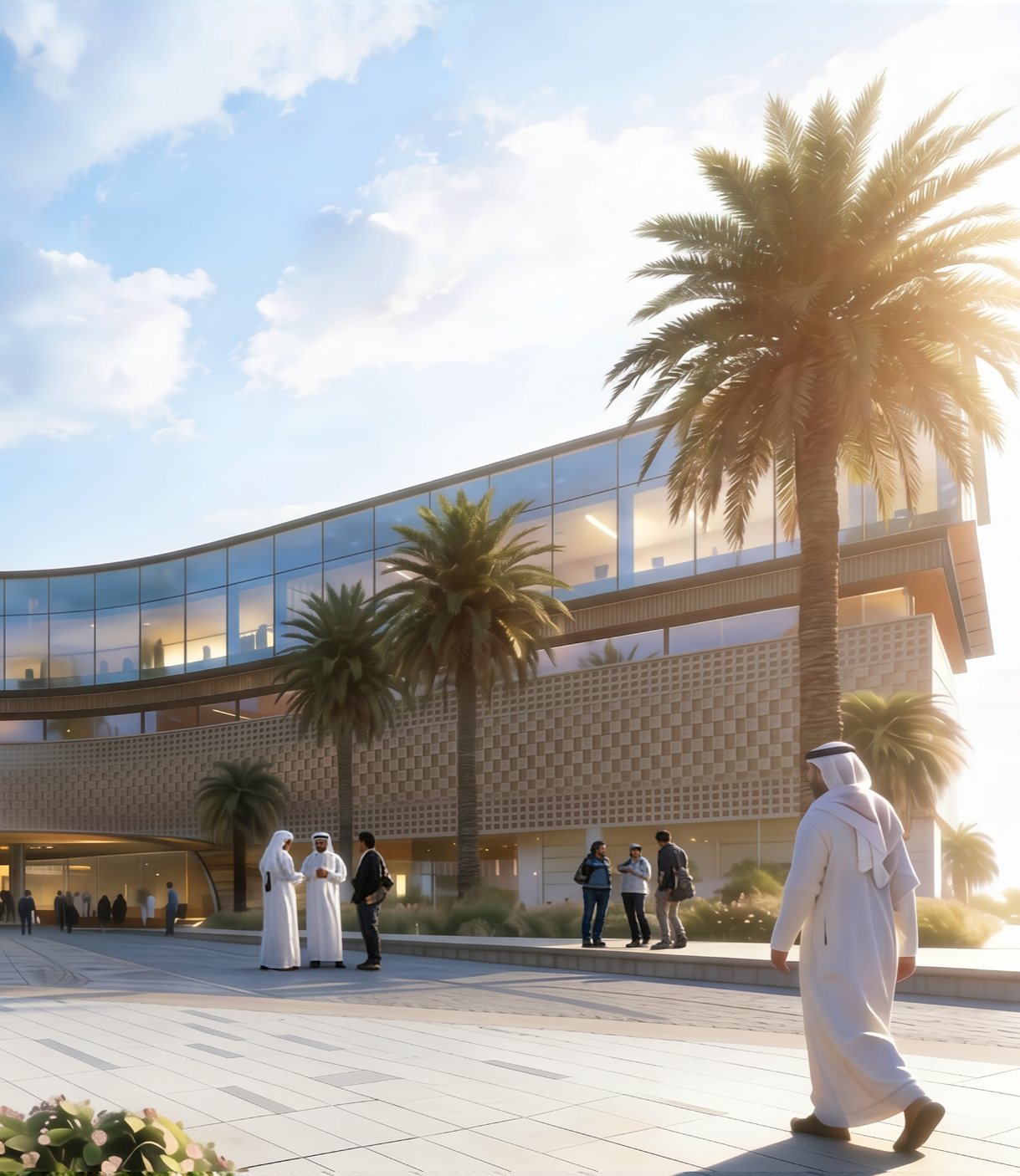
Design Philosophy
Innovation in the project’s design is reflected in the precision of its planning:
The total built-up area is 159,701.36 square meters, incorporating a variety of functions.
Environmentally sustainable strategies are integrated to achieve comfort and efficiency.
A thoughtful division of zones enhances the user experience — for example, placing the colleges in the central block to offer diverse panoramic views while optimizing interior spaces for the best environmental orientation, and locating residential units in separate areas to ensure privacy.
The project stands as a beacon of contemporary design, rooted in respect for cultural identity. It is an architectural narrative that blends progress with tradition, crafted to shape Jeddah’s skyline and enhance its global standing.
Executive Overview
Strategic Concept Brief
The University of Artificial Intelligence & Technology (UAIT), currently under establishment in Jeddah, Kingdom of Saudi Arabia, is being founded as a next generation, AI-first university designed to serve as a global bridge between leading research institutions and the rapidly transforming economies of the Middle East.
Established by a founding leadership team, including its Co-Founder, UAIT is aligned with Saudi Arabia’s Vision 2030 agenda, which places artificial intelligence, digital transformation, and knowledge economy development at the center of national strategy.
National Transformation Context
Saudi Arabia is undergoing one of the most ambitious economic diversification programs globally. Artificial intelligence, smart infrastructure, digital governance, and advanced automation are central pillars of this transformation. The Kingdom has committed significant national resources toward developing AI capabilities across sectors including energy, logistics, healthcare, urban development, financial services, and tourism.
UAIT is designed to contribute directly to this transformation by serving as a specialized academic and research engine in AI and advanced technology.
Geographic and Regional Positioning
Located in Jeddah, UAIT occupies a strategic position linking Europe, Africa, and Asia. The institution aims to serve a region of more than 400 million Arabic speakers and a broader emerging market with rapidly increasing demand for AI expertise. The university will also focus on high-impact regional research domains, including Arabic-language AI systems, smart infrastructure applications, AI governance frameworks, and intelligent tourism systems relevant to emerging economies.
Institutional Differentiation
UAIT is structured as a vertically integrated AI ecosystem, spanning undergraduate, graduate, doctoral, and executive education programs.
Unlike specialized graduate-only institutions such as Mohamed bin Zayed University of Artificial Intelligence, UAIT will integrate foundational computing education with advanced AI research pathways. Unlike broader research universities such as King Abdullah University of Science and Technology, UAIT will adopt a focused, AI-centric institutional identity from inception, combining research excellence with real-world deployment partnerships across multiple economic sectors
Academic & Research Vision
UAIT will launch with a defined set of flagship AI research domains designed to enable both foundational innovation and applied impact, while embedding artificial intelligence methodologies across technical and professional disciplines.
Core AI Research Domains
• Machine Learning & Foundation Models
Advanced research in scalable learning systems, large-scale model architectures, domain- specific AI applications, and next-generation computational frameworks.
• Robotics & Autonomous Systems
Intelligent robotics, autonomous mobility systems, industrial automation, and advanced human–machine interaction technologies.
• AI for Smart Infrastructure & Cities
Urban optimization systems, energy modeling, logistics intelligence, predictive infrastructure management, and data-driven governance technologies.
• AI Ethics, Policy & Governance
Responsible AI development, regulatory innovation, global policy research, algorithmic accountability, and ethical deployment frameworks.
• Arabic Language & Multimodal AI Systems
Development of high-performance Arabic language models and culturally contextualized multimodal AI technologies serving regional and global markets.
AI-Integrated Colleges & Applied Education Model
In addition to its core AI research agenda, UAIT will establish colleges designed to embed artificial intelligence as a foundational methodology across engineering and professional disciplines.
The university will initially establish the following AI-integrated colleges:
College of Intelligent Engineering & Autonomous Systems
This college will integrate engineering disciplines through an AI-first
framework rather than a traditional departmental structure. Focus areas will include:
• AI-driven electrical and embedded systems
• Autonomous robotics engineering
• Smart infrastructure engineering
• Sustainable energy systems optimization
• Industrial automation and advanced manufacturing systems
The objective is to develop engineers capable of designing, deploying, and scaling intelligent systems across physical and digital environments.
College of Business Administration
Embedding AI into finance, strategy, operations, marketing analytics, digital
transformation, and intelligent enterprise systems. The curriculum will
emphasize AI-driven decision-making, predictive analytics, and automation
in business ecosystems.
College of Tourism & Hospitality Innovation
Leveraging AI for smart tourism systems, destination analytics, dynamic
pricing models, experience personalization, sustainable tourism planning,
and intelligent service operations aligned with regional tourism expansion
initiatives.
College of Law & Technology Policy
Focusing on AI governance, digital regulation, cyber law, data protection,
algorithmic accountability, intellectual property in AI systems, and
emerging technology jurisprudence. This college will support the
development of legal frameworks for AI deployment across emerging
markets.
Institutional Research Infrastructure
To support both core AI research and cross-disciplinary AI integration, UAIT intends to establish:
• Jointly branded AI research centers
• Co-supervised doctoral programs
• Distinguished international visiting AI chairs
• Cross-college AI innovation laboratories
• Annual global AI research forums hosted in Jeddah
This structure ensures that artificial intelligence is not treated as a standalone technical discipline, but as a foundational capability
embedded across engineering, economic, regulatory, and societal domains.
Proposed Partnership Framework
UAIT is exploring structured partnership models designed for depth, institutional integration, and long-term alignment.
Tier I – Strategic Research Alliance
• Joint AI research centers with shared governance structures
• Co-funded multi-year research initiatives
• Dual-supervision doctoral programs
• Long-term faculty mobility and visiting scholar exchanges
Tier II – Academic Collaboration
• Curriculum co-development and academic advisory roles
• Executive education and professional AI leadership programs
• Joint research workshops and symposia
Tier III – Global Advisory Engagement
• Participation in a Founding Global AI Advisory Council
• Strategic roundtable participation shaping UAIT’s long-term direction
UAIT seeks partnerships grounded in sustained collaboration, measurable research output, and institutional integration.
Institutional Commitments
UAIT’s founding phase includes:
• Dedicated AI campus infrastructure in Jeddah
• Allocated founding research capital to support joint initiatives
• Alignment with national AI and digital transformation policies
• Structured engagement with industry partners across key sectors
• Long-term endowment and sustainability planning
The university is being structured to ensure academic independence, global standards of governance, and long-term research continuity.
Long-Term Ambition
UAIT’s 10–15 year ambition is to become:
• A globally recognized AI-specialized university
• A leading AI research and innovation hub across the MENA region
• A strategic alliance partner for globally recognized institutions including Massachusetts Institute of Technology, Carnegie Mellon University, and Imperial College London
UAIT intends to compete internationally in research output, faculty recruitment, and graduate training while maintaining strong regional deployment impact.

Proposed Colleges
College of Engineering
College of Computer Science
Two Separate Colleges with Identical Layouts
Floor Area: 40 m × 60 m = 2,400 m²
Floors: Ground + 4
Total Area: 12,000 m²
Construction Cost per m²: 2,500 SAR/m²
Total Cost: 30,000,000 SAR
Ground Floor: Classrooms + Lecture Halls + Services
First Floor: Classrooms + Laboratories + Services
Second Floor: Classrooms + Laboratories
Third Floor: Department Heads’ Offices
Fourth Floor: College Administration Offices
Number of Lecture Halls: 4
Number of Classrooms: 23
Number of Laboratories: 6
Number of Offices: 8 (with secretarial offices)
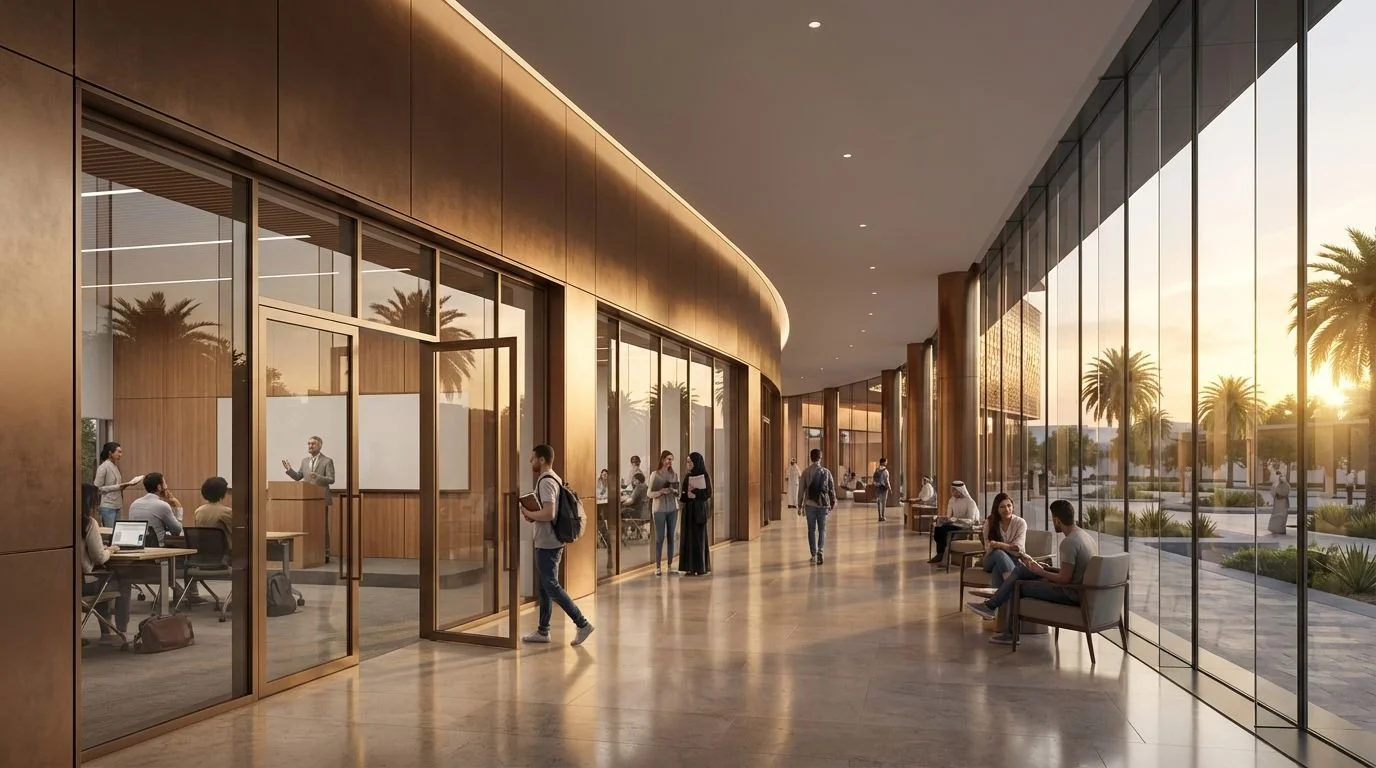
Proposed Colleges
College of Business Administration
College of Law
College of Tourism
Three Separate Colleges with Identical Layouts
Floor Area: 20 m × 50 m = 1,000 m²
Floors: Ground + 4
Total Area: 5,000 m²
Construction Cost per m²: 2,500 SAR/m²
Total Cost: 12,500,000 SAR
Ground Floor: Classrooms + Lecture Halls + Services
First Floor: Classrooms + Lecture Halls + Services
Second Floor: Department Heads’ Offices + Faculty Offices
Third Floor: Department Heads’ Offices + Faculty Offices
Fourth Floor: College Administration Offices
Number of Lecture Halls: 2
Number of Classrooms: 18
Number of Offices: 42
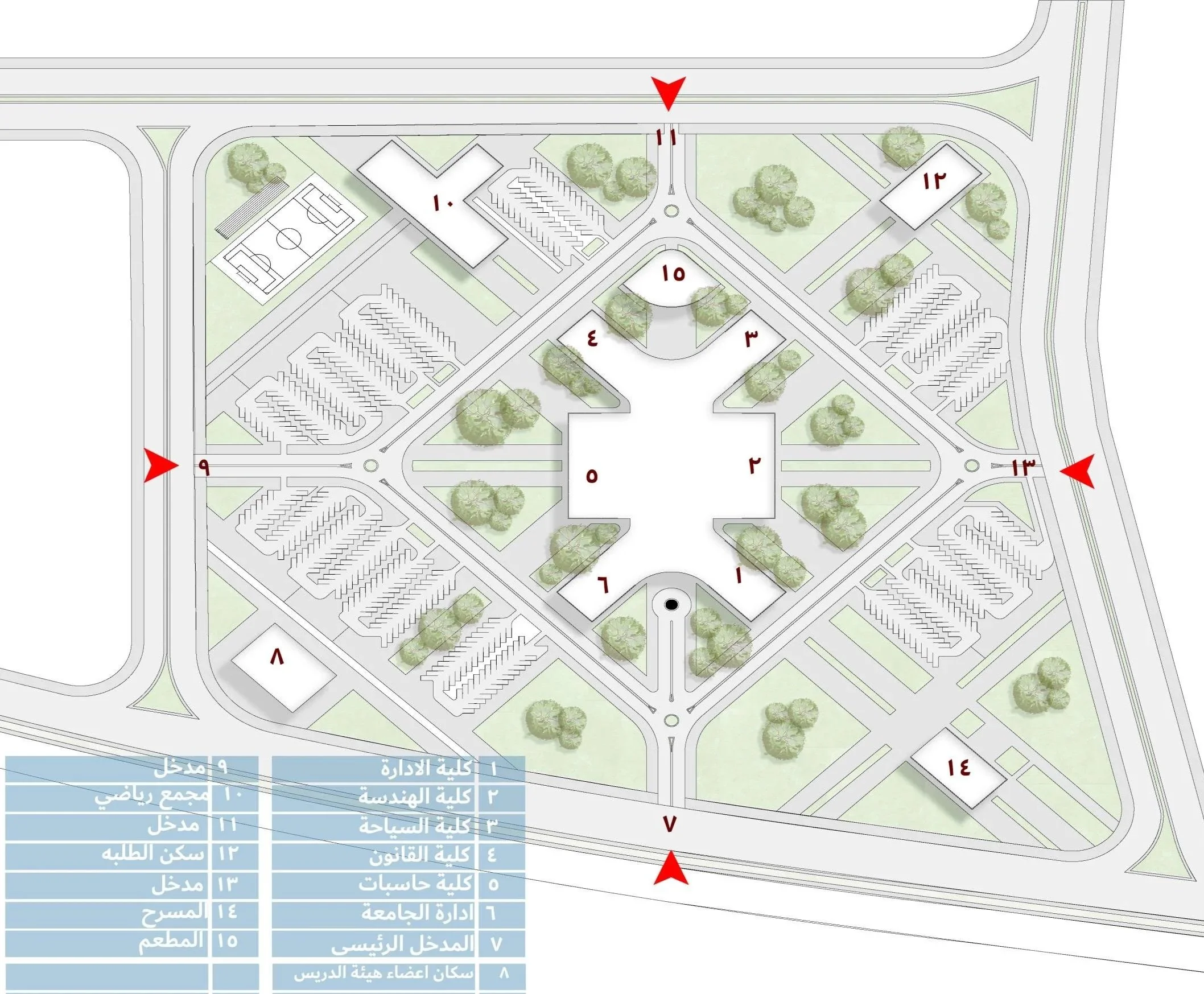
Proposed College Layout
College of Business Administration
College of Engineering
College of Tourism
College of Law
College of Computer Science
University Administration
Main Entrance
Faculty Housing
Entrance
Sports Centre
Entrance
Student Housing
Entrance
Theatre
Restaurant